


Solutions
Chemical Solutions
Practical chemical sourcing solutions tailored to different industries and application needs.
recommend
 Choosing Polyacrylamide Grades by Sludge Dewatering Cost and Cake Solids
 Custom Chemical Packaging: Leak Tests and Compliance Checks for Hazardous Transport
 How Ferroalloy Chemistry Influences Inclusion Control in High-Strength Steel
 Water Treatment Chemicals: Building a Dosing Program for Variable Wastewater Loads

Send Us A Message
Water Treatment Chemicals: Building a Dosing Program for Variable Wastewater Loads
Water Treatment Chemicals: Building a Dosing Program for Variable Wastewater Loads
Variable wastewater is where many otherwise sound treatment systems begin to drift. A plant may see steady production for most of the week, then receive a high-strength discharge after cleaning, batch changeover, or an upstream upset. Flow changes, pH shifts, suspended solids rise, and the existing chemical dose suddenly becomes either insufficient or wasteful. For project managers, the objective is not simply to add more water treatment chemicals. It is to build a dosing program that responds predictably when the wastewater does not.
The starting point is to separate hydraulic variation from contaminant variation. A higher flow rate does not always mean a higher pollutant load, and a low-flow period can still carry a concentrated batch discharge. Designing dosage around flow alone is a common shortcut, but it can lead to poor coagulation, unstable sludge formation, residual chemical carryover, or unnecessary chemical consumption.
Build the program around the load, not a single average sample
Before selecting a control strategy, review how the wastewater behaves across operating conditions. Useful information includes influent flow, pH, conductivity, turbidity or suspended solids, COD where relevant, oil content, temperature, and the timing of production events. A composite sample can show the average picture, but it may hide the peaks that actually cause compliance risk. Grab samples taken during CIP cycles, product changeovers, or peak discharge periods are often more useful for defining dose limits.
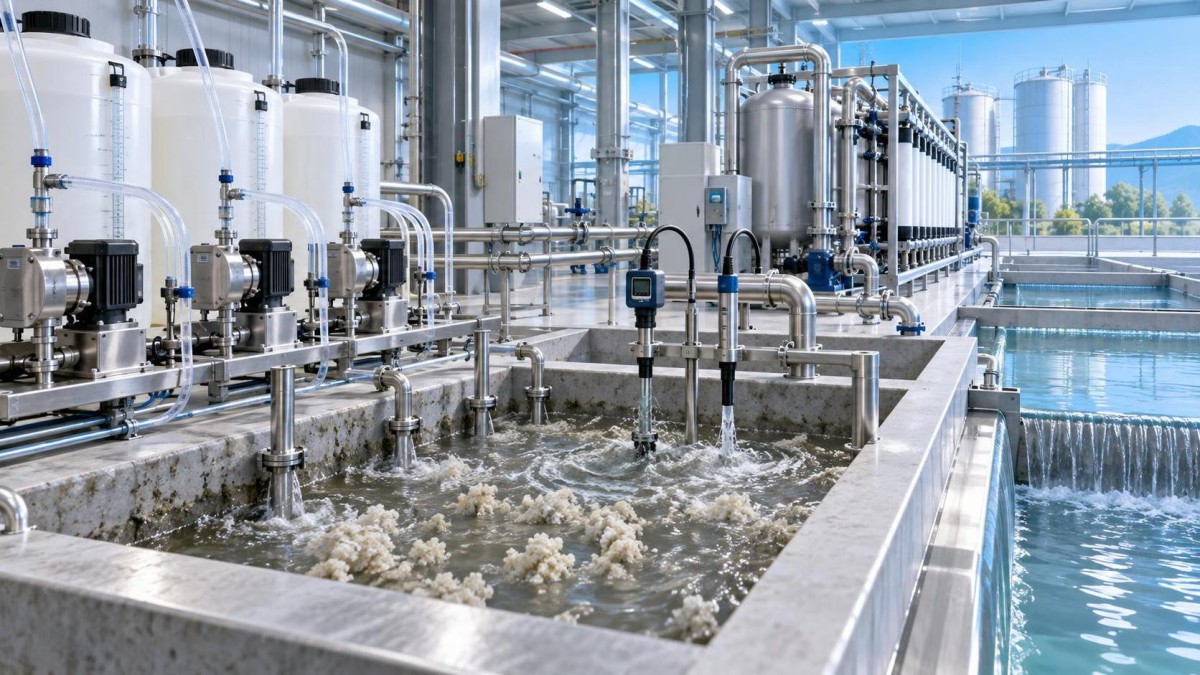
For coagulation and flocculation, jar testing remains a practical decision tool. It helps determine whether the main issue is charge neutralization, solids capture, emulsion breaking, or pH adjustment. It also reveals an important reality: more coagulant is not automatically safer. Overdosing can reverse particle charge, increase residual metals or salts, and create a sludge dewatering problem downstream.
Use layered control instead of one fixed pump setting
A robust dosing program usually combines a baseline dose with adjustment triggers. Flow-paced dosing is a sensible foundation when influent quality is reasonably consistent. Where composition changes materially, flow pacing should be supplemented by online signals such as pH, turbidity, conductivity, oxidation-reduction potential, or a monitored process parameter that reflects the actual contaminant change.
The control logic does not need to be overly elaborate on day one. In many industrial projects, a practical approach is to establish a normal operating window, a high-load dose range, and an alarm condition requiring operator verification. Automated adjustment is valuable, but only when the instrument readings are reliable and the plant has a clear response plan for sensor drift, calibration failure, or abnormal influent.
- Keep separate dose recipes for routine production, washdown, and known high-strength events.
- Set mixing and retention time before judging chemical performance; poor hydraulics can look like a chemistry problem.
- Track chemical consumption against treated volume and sludge output, not treated volume alone.
- Review residuals and final discharge quality after any major change in raw materials or production scheduling.
Choose chemicals with the operating system in mind
Chemical selection should account for storage conditions, dosing equipment, worker handling requirements, downstream biological treatment, and sludge disposal route. For example, an effective coagulant may be a poor project choice if it creates a residual that interferes with a membrane system or complicates disposal. Likewise, a polymer that performs well in a jar test may need different make-down conditions and aging time before it performs consistently at full scale.
Supply decisions are part of dosing reliability. High-purity chemical raw materials, compatible packaging, accurate labeling, and dependable logistics reduce the risk of receiving inconsistent material or facing an unplanned dosing interruption. For international industrial sites, it is worth confirming package size, container compatibility, transport classification, storage life, and local unloading capability before finalizing the treatment chemical program. A formulation is only useful if it arrives safely and can be handled correctly on site.
Treat commissioning as the beginning of optimization
A dosing program should not be frozen at commissioning. During the first operating period, compare the planned dose curve with actual influent conditions, effluent results, sludge behavior, and operator observations. If the process becomes unstable at certain times of day, investigate the upstream discharge pattern before changing products. Often the better answer is equalization, improved mixing, or a timed pre-dose rather than a stronger chemical.
The most dependable water treatment chemicals program is one that gives the operations team defined limits, usable monitoring signals, and room to respond to real production changes. That is more valuable than chasing a single “optimal” dose that only works under average conditions.