


Solutions
Chemical Solutions
Practical chemical sourcing solutions tailored to different industries and application needs.
recommend
 Choosing Polyacrylamide Grades by Sludge Dewatering Cost and Cake Solids
 Custom Chemical Packaging: Leak Tests and Compliance Checks for Hazardous Transport
 How Ferroalloy Chemistry Influences Inclusion Control in High-Strength Steel
 Water Treatment Chemicals: Building a Dosing Program for Variable Wastewater Loads


Send Us A Message
Custom Chemical Packaging: Leak Tests and Compliance Checks for Hazardous Transport
A hazardous-material package is acceptable only when the container, closure, secondary containment, marking, and transport documents describe the same shipment. A sound drum can still fail a compliance review when its closure is incompatible with the chemical, the test method does not represent the filled condition, or the declared package configuration differs from what is loaded.
Start with the complete containment system
Leak performance cannot be judged from the primary container alone. The relevant system includes the bottle, pail, drum, jerrican, or intermediate bulk container; caps, bungs, gaskets, vents, liners, tamper evidence, and any overpack. Material compatibility must be evaluated against the chemical concentration, moisture content, temperature range, and expected storage duration. A gasket that remains stable during a short warehouse hold may soften, swell, or lose compression after prolonged contact or elevated transport temperatures.
High-purity materials add another constraint: packaging must prevent outward leakage without introducing contamination. Selection therefore needs to consider extractables from liners and closures, particle shedding, moisture ingress, and residue from cleaning or reconditioning. Reused packaging requires defined inspection and cleaning controls; external appearance alone does not confirm that threaded openings, valve seats, or sealing surfaces remain suitable.
Make leak testing representative
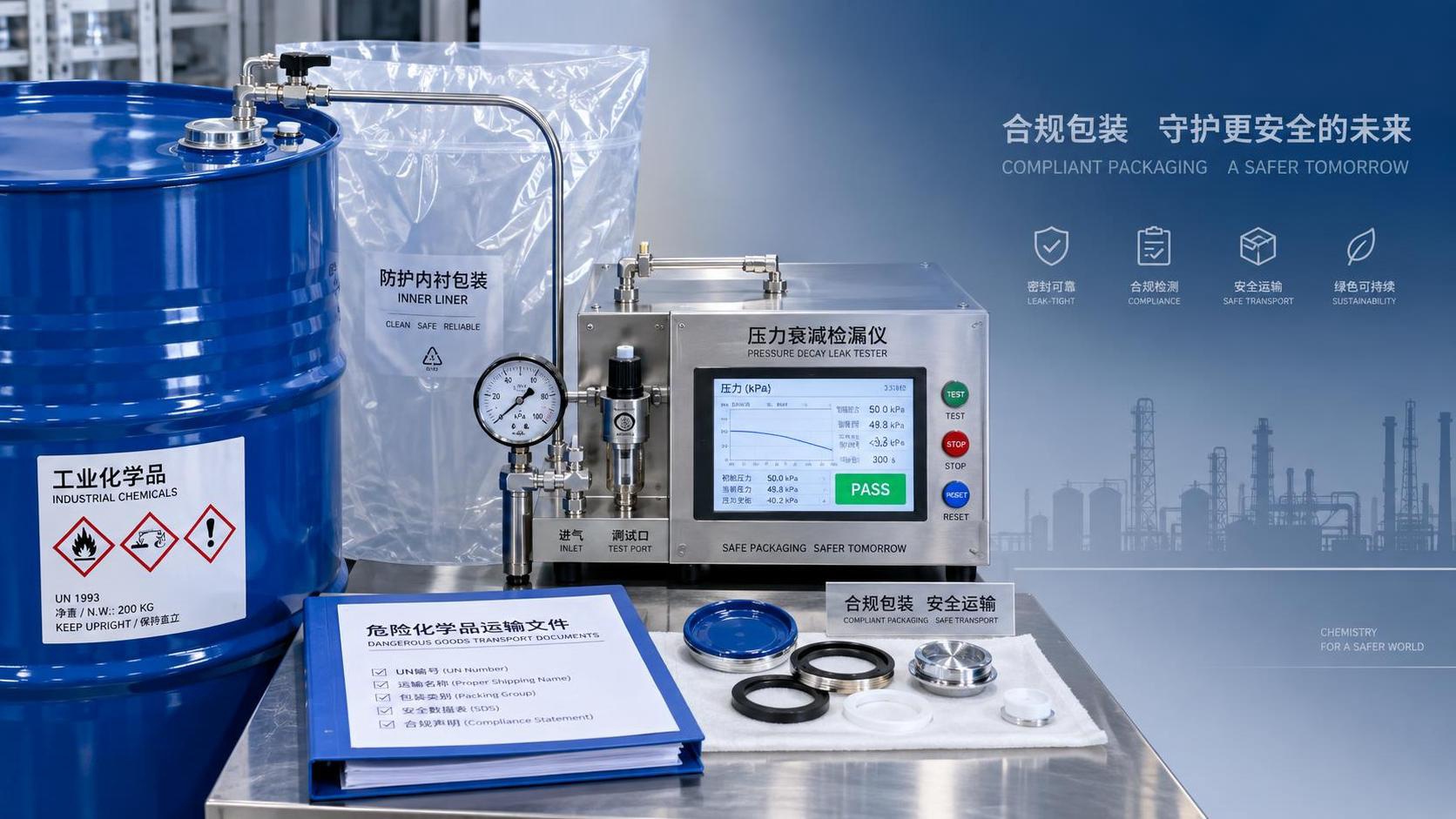
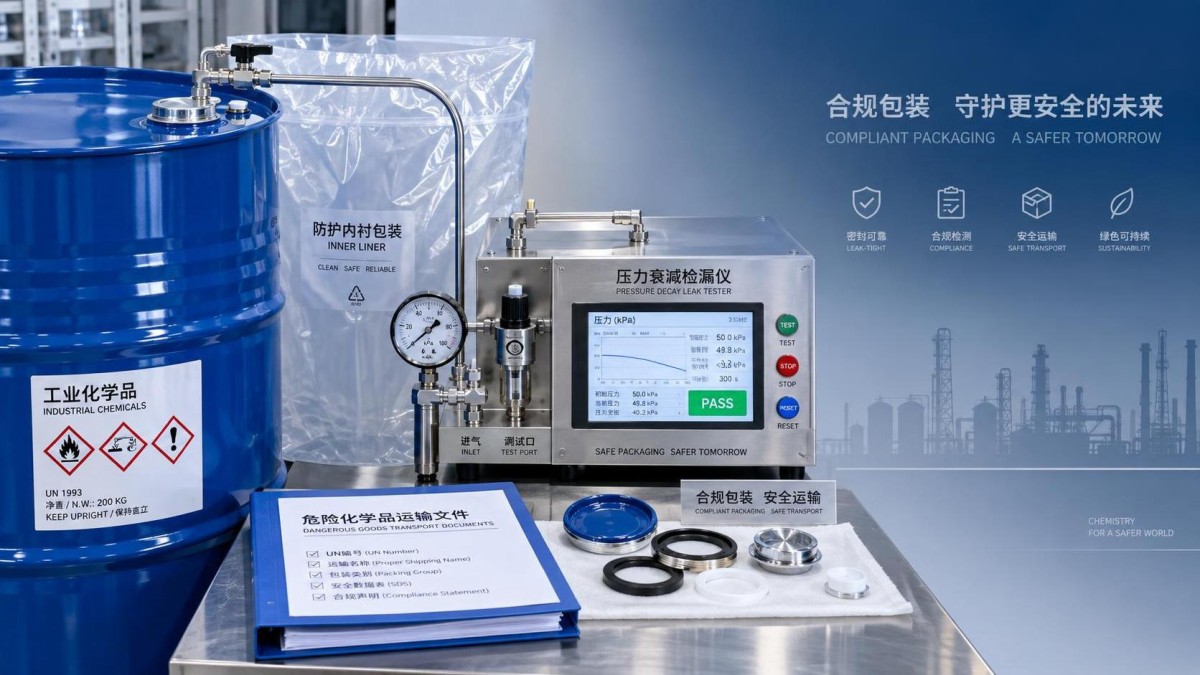
A leak test has value only when its pressure, dwell time, orientation, and closure condition reflect the approved package design. Testing an empty container at a convenient pressure may reveal gross defects, yet miss a closure leak caused by liquid contact, hydrostatic head, thermal movement, or a slightly damaged sealing face.
Pressure-decay methods are useful for detecting loss from sealed packages, but results can be distorted by temperature stabilization, flexible container walls, or trapped air volume. A pressure change is not automatically a leak. The test setup should establish a stabilization period and acceptance logic that separates normal material expansion from an actual loss of containment. For packages tested with liquid, visual inspection around seams, bungs, valves, handles, and closure threads remains necessary because slow weeping may not produce an immediate measurable pressure change.
- Closure torque or tightening method should be controlled before testing. Under-tightening and over-tightening can both damage sealing performance.
- Test the assembled configuration, including liner, vent, dip tube, or valve where supplied. Removing a component changes the result.
- Record package type, batch or serial identification, test conditions, instrument status, result, and disposition. A pass result without traceability cannot support release decisions.
Transport compliance is configuration-specific
Hazardous transport rules commonly distinguish between the substance classification, packing group where assigned, authorized packaging type, quantity limits, and transport mode. These elements must be reviewed together. A package suitable for one mode may require different marking, documentation, or performance evidence for another. The same material can also require different packaging controls when shipped as a liquid versus a solid, at elevated temperature, or with a residual vapor pressure.
Package markings should remain legible after handling and should correspond to the actual inner and outer packaging. Labels, orientation arrows where applicable, package marks, and shipping descriptions need a final cross-check against the released transport document. A frequent source of delay is not a missing label but a mismatch between the product name, hazard classification, net quantity, and package configuration stated across records.
Inspect failures by location and pattern
A wet area beneath a package does not always identify the failure point. Leakage from a bung can travel along a curved surface and appear at a lower seam. Condensation, external wash water, and residue from filling can create similar evidence. Inspection should begin by cleaning and drying the exterior, then examining the closure, seam, valve, and base under controlled conditions. Recurrent leakage at one location suggests a packaging or assembly issue; irregular occurrences may point to handling damage, incompatible fill conditions, or inconsistent closure application.
Before release, the shipping record should connect the material specification, approved packaging configuration, inspection result, hazard communication, and dispatch condition. That linkage turns leak testing from an isolated factory test into evidence that the package placed into transport matches the package that was evaluated.