


News
Industry Insights
Stay informed with chemical market insights, product knowledge and industry developments.
recommend
 Amino Acids in Industrial Formulations: Functions, Grades, and Selection Criteria
 Selecting Quaternary Ammonium Compounds for Surface Disinfection Applications
 How Custom Chemical Packaging Reduces Leakage, Compliance, and Transport Risks
 Ferroalloy Procurement: Evaluating Composition, Impurities, and Delivery Reliability
Send Us A Message
How Polyacrylamide Grade and Molecular Weight Affect Industrial Water Treatment
In industrial water treatment, Polyacrylamide selection is rarely a matter of choosing the “strongest” product. Grade and molecular weight influence how the polymer reaches suspended particles, forms flocs, survives shear, and releases water from sludge. A product that performs well in a jar test can still create unstable clarification or poor dewatering when its charge type, molecular architecture, make-down quality, or dosage window does not match the process.
For operators, the practical question is straightforward: which polymer property is limiting treatment performance right now? If the clarifier produces pin floc, molecular weight or charge density may be insufficient. If the sludge press runs slowly or filtrate becomes cloudy after a product change, the issue may be overdosing, poor polymer activation, excessive shear, or a grade designed for a different sludge type. Grade and molecular weight should therefore be assessed together, against the water chemistry and equipment conditions rather than as independent purchasing specifications.
Grade determines how the polymer interacts with the solids
Polyacrylamide grades are commonly differentiated by ionic character: anionic, cationic, nonionic, and, in some applications, amphoteric formulations. The ionic character determines the primary attraction between the polymer and suspended matter. Molecular weight then affects how effectively that attraction is translated into bridging and floc growth.
Anionic grades carry negatively charged functional groups. They are often used where particles have been destabilized with inorganic coagulants, where metal hydroxide solids are present, or where mineral-rich suspensions respond well to polymer bridging. Their performance depends heavily on water hardness, pH, coagulant chemistry, and the surface charge of the solids. An anionic product can work efficiently after an alum or iron salt stage, yet be ineffective if the upstream process leaves particles insufficiently neutralized.
Cationic grades are widely associated with sludge conditioning and dewatering because many biological sludges, organic colloids, and fine suspended solids carry a net negative charge. A cationic polymer can neutralize repulsive forces and promote the formation of larger, drainable flocs. However, “more cationic” does not automatically mean better dewatering. Excessively high charge density may produce compact-looking flocs that retain water, shear apart in pumping, or release polymer into the filtrate if the dose exceeds the available particle surface.
Nonionic grades are useful where charge-based interaction is weak or where water chemistry makes strongly ionic polymers difficult to control. They may also be considered for selected mineral, acidic, or low-charge suspensions. Their action relies more on adsorption and physical bridging, so molecular weight and mixing conditions often become especially important.
Amphoteric polymers combine positive and negative functional groups. They can be useful for difficult sludges with variable composition, but they should not be treated as a universal solution to variability. A variable feed may be caused by upstream chemical changes, solids concentration swings, temperature shifts, or biological process instability. A broader-tolerance polymer may help, but it cannot correct a poorly controlled conditioning sequence.
Charge density is not the same as polymer grade
Within an anionic or cationic family, charge density can vary substantially. It describes the relative level of charged functional groups along the polymer chain. In practice, charge density affects adsorption speed, charge neutralization, floc structure, and dosage sensitivity.
Higher charge density often gives faster interaction with oppositely charged particles. This can be useful when solids are highly charged or when hydraulic residence time is limited. The trade-off is a narrower operating window in some systems. Once the particle charge has been neutralized, additional polymer may reverse the charge or create a dispersed, sticky suspension rather than a stronger floc.
Lower charge density grades may be more dependent on long-chain bridging and may tolerate some conditions differently, particularly when large flocs are desired for settling or drainage. Their response can be slower, and they may require enough mixing time for the polymer to contact the available particle surface. The best grade is therefore linked to the treatment objective: rapid clarification, thickening, centrifuge capture, belt press drainage, filter press cake release, or dissolved air flotation all place different demands on the floc.
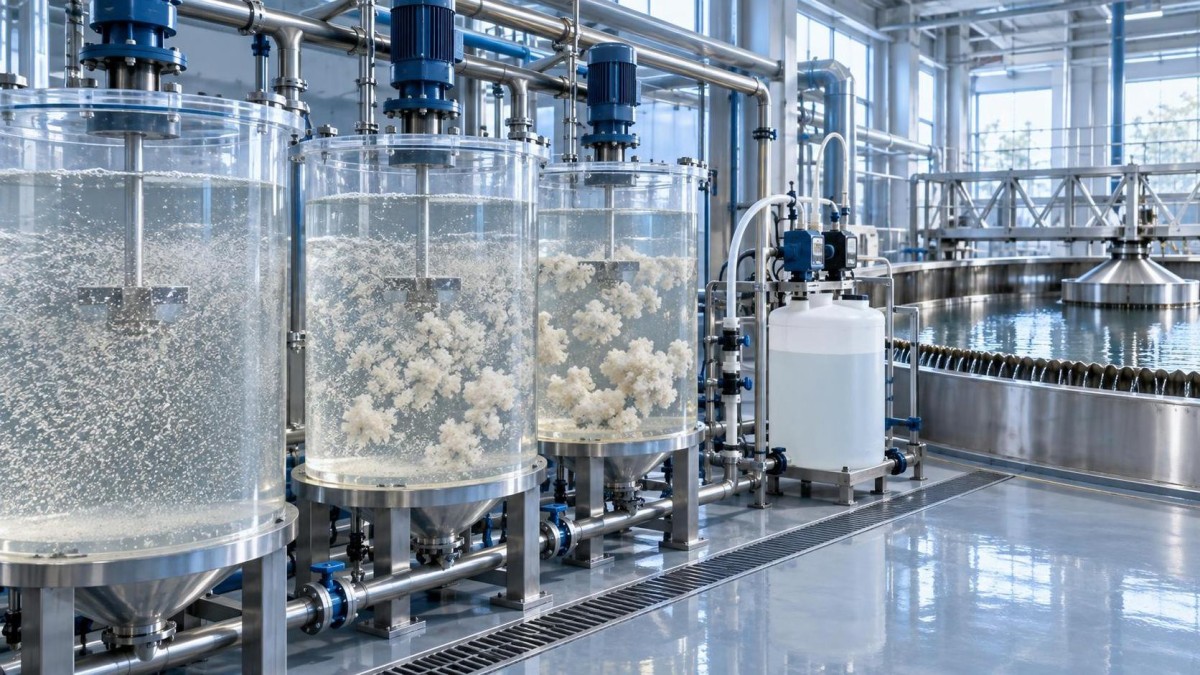
Molecular weight affects floc size, strength, and handling tolerance
Molecular weight is often described as chain length. This simplification is useful as long as it is not taken too literally. In treatment performance, higher molecular weight generally provides longer polymer chains and greater bridging potential. A single chain can connect multiple particles, helping form visible flocs that settle, float, or dewater more effectively.
For clarification and thickening, a higher-molecular-weight grade may improve capture of fine suspended solids by producing larger aggregates. For sludge dewatering, it may create a more open floc structure that releases water under gravity, compression, or centrifugal force. But longer chains are also more vulnerable to mechanical damage. High-shear pumps, aggressive inline mixers, narrow valves, and prolonged recirculation can reduce effective chain length before the polymer reaches the point of use.
A lower-molecular-weight product may dissolve or disperse more readily and can offer more predictable performance in a system with demanding mixing conditions. It may also be better suited where rapid adsorption is more important than creating very large bridges. Its limitation is that it may not generate sufficient floc size or strength for difficult fine solids, especially when the process needs large, fast-settling particles.
Operators should avoid treating molecular weight as a direct performance ranking. Very high molecular weight can create oversized flocs that break during downstream transport. It can also increase solution viscosity, making dilution, aging, and feed control more difficult. When a product is difficult to activate uniformly, the apparent treatment problem may actually be a preparation problem: partially hydrated polymer particles, uneven concentration, or localized overdosing can all undermine the expected benefit of a high-molecular-weight grade.
Floc strength and floc size are separate observations
A large floc is not always a robust floc. Clarification systems often benefit from flocs large enough to settle without carrying excess water or trapping gas. Dewatering equipment needs flocs that retain solids under shear but still release water through the media. These requirements can conflict.
For example, a polymer may produce dramatic flocculation in a beaker, then fail after the conditioned sludge passes through a transfer pump. Another product may form smaller flocs visually but deliver clearer centrate because its structure withstands the actual shear path. Visual appearance is useful during screening, but final selection must include the equipment and hydraulic conditions that exist after conditioning.
Match the polymer to the treatment step, not just the wastewater label
“Industrial wastewater” is too broad a description for polymer selection. The same facility may have separate streams with different solids chemistry, pH, oil content, metal content, conductivity, temperature, and coagulant residual. A Polyacrylamide grade selected for primary clarification may be unsuitable for biological sludge dewatering, even when both streams originate from the same site.
For clarification, the central issues are particle charge, particle size, settling rate, and the chemistry already added upstream. If coagulation is used, polymer selection should begin after establishing the coagulant dose and pH range. Changing both coagulant and polymer at once makes it difficult to identify why performance changed. A modest adjustment to coagulation may reduce the polymer requirement more effectively than switching among similar polymer grades.
For dissolved air flotation, flocs must attach to bubbles and remain intact as they rise. A polymer that creates dense settling flocs may not provide the structure needed for stable flotation. Fine adjustment of charge density, molecular weight, and addition point can be more important than increasing dose.
For thickening and dewatering, solids concentration is a major variable. A sludge that is diluted beyond its usual range presents less particle surface per unit volume, changes mixing behavior, and can require a different polymer solution concentration or feed rate. The polymer may appear to underperform even though its chemical grade is appropriate. Feed solids should be monitored alongside filtrate clarity, cake dryness, capture rate, throughput, and polymer consumption.
- Primary clarification: prioritize rapid aggregation, settleability, and compatibility with upstream coagulation.
- DAF treatment: assess bubble-compatible floc structure, float stability, and clarity of the treated water.
- Sludge thickening: look for solids capture and drainage without creating a compact, water-bound sludge layer.
- Centrifuge dewatering: test floc survival through high shear and evaluate centrate quality together with cake solids.
- Belt or filter press dewatering: evaluate drainage rate, cake release, filtrate quality, and whether the floc plugs the media.
Why laboratory results often fail to transfer directly to operation
Jar testing is essential for narrowing product choices, but it represents only part of the process. The test should reflect the actual sequence of dilution, mixing, conditioning time, and shear as closely as possible. A test that adds concentrated polymer directly into a beaker may favor products that would not distribute properly at full scale.
Polymer preparation is one of the most common reasons for inconsistent results. Powder products require controlled wetting, adequate aging time, and gentle enough mixing to avoid damaging the polymer after hydration. Emulsions and dispersions have different activation requirements, including correct inversion and dilution procedures. A grade cannot compensate for an incompletely prepared solution.
Water quality used for make-down also matters. High hardness, incompatible pH, residual oxidants, or contaminants can affect dissolution and polymer integrity. The age of the prepared solution may influence performance as well. Operators should establish a practical preparation window for the selected product and avoid assuming that a solution prepared under one set of conditions will behave identically after extended holding or process interruptions.
Addition point is equally important. The polymer needs enough energy to disperse through the slurry, followed by a lower-shear zone where flocs can grow. If it is injected before a severe pump, valve, or mixer, the system may destroy much of the flocculation benefit. If it is added too late or into a poorly mixed pipe section, localized overdosing and uneven flocculation can occur.
Use operating symptoms to guide grade and molecular-weight adjustments
When treatment performance drifts, changing to a different product should not be the first response. Start by checking whether the incoming solids, pH, conductivity, temperature, coagulant demand, or sludge concentration has moved outside the established operating range. Then confirm polymer solution concentration, aging time, feed calibration, injection location, and mixing equipment condition.
Once these conditions are stable, observed symptoms can help direct a controlled trial. Fine, slow-settling flocs may indicate insufficient bridging, inadequate coagulation, or poor polymer distribution. A higher molecular weight or a different charge density may help, but only after confirming that the dose is reaching the particles uniformly.
Sticky floc, cloudy filtrate after a dose increase, or a sudden rise in polymer consumption can indicate overdosing or charge imbalance. In that situation, a lower dose, lower charge density, or a different grade may outperform a more aggressive polymer. Poor cake drainage with acceptable solids capture may point to floc structure rather than capture efficiency; a grade that produces a more open, shear-resistant floc can improve press performance without increasing the dose.
Trials should compare products at multiple dosage points rather than at one “best guess” dose. Record the full response curve: treated-water clarity, capture, settling or drainage behavior, cake solids where relevant, and operational stability. The lowest apparent polymer dose is not always the lowest operating cost if it reduces throughput, increases rework, or destabilizes downstream treatment.
A practical selection sequence
A disciplined selection process begins with the treatment target and the stream condition, then works backward to the polymer. Define whether the main constraint is suspended-solids removal, sludge capture, filtrate clarity, cake dryness, throughput, or a combination of these. Identify the normal and abnormal ranges of pH, solids concentration, coagulant use, conductivity, and temperature. Those ranges matter more than a single grab sample.
Screen ionic type and charge density first, then compare molecular weights within the most promising grade family. Run the final candidates through conditions that represent the real equipment path, including dilution, mixing, transfer shear, and realistic conditioning time. Maintain the same solution preparation protocol during comparisons. Otherwise, the test may measure differences in activation quality rather than differences between polymers.
The final operating specification should include more than the product name and target dose. It should define preparation concentration, aging time, dilution water expectations, feed-point location, acceptable process indicators, and the response when incoming sludge changes. That turns polymer selection from a one-time chemical purchase into a controllable part of the water-treatment process.
Grade establishes the chemical fit; molecular weight shapes the bridging and mechanical behavior. Neither property can be selected reliably in isolation. When both are evaluated against the actual solids, upstream chemistry, and equipment shear, Polyacrylamide becomes easier to control and far less likely to be blamed for problems originating elsewhere in the treatment train.