


News
Industry Insights
Stay informed with chemical market insights, product knowledge and industry developments.
recommend
 Amino Acids in Industrial Formulations: Functions, Grades, and Selection Criteria
 Selecting Quaternary Ammonium Compounds for Surface Disinfection Applications
 How Custom Chemical Packaging Reduces Leakage, Compliance, and Transport Risks
 Ferroalloy Procurement: Evaluating Composition, Impurities, and Delivery Reliability
Send Us A Message
Selecting Quaternary Ammonium Compounds for Surface Disinfection Applications
Selecting Quaternary Ammonium Compounds for Surface Disinfection Applications
Selecting Quaternary Ammonium Compounds for a surface disinfection program is rarely a matter of choosing the strongest available active ingredient. Quality-control and safety teams need a formulation that performs against the relevant microorganisms, remains compatible with actual working surfaces, fits the cleaning routine, and can be handled consistently by operators on every shift.
This distinction matters in industrial facilities. A disinfectant that looks effective in a controlled evaluation may deliver uneven results on a production floor if surfaces are not cleaned first, the dilution is incorrect, or the liquid dries before the required contact time is reached. Conversely, an overly aggressive chemistry can create avoidable issues with coatings, seals, packaging equipment, or worker acceptance.
Quaternary ammonium compounds, commonly called quats or QACs, remain widely used because they can offer practical broad-spectrum surface sanitation characteristics, good handling convenience, and formulation flexibility. Their suitability, however, depends on details that are often treated as secondary during procurement: active composition, use concentration, water quality, formulation additives, residual film, packaging, transport classification, and the claims permitted in the destination market.
Start With the Real Disinfection Task, Not the Chemical Name
“Quat disinfectant” is not a single performance category. Different quaternary ammonium compounds have different molecular structures and may be blended to achieve a particular balance of antimicrobial activity, detergency, stability, odor, foam behavior, or compatibility. Common industrial actives may include benzalkonium chloride-based materials and dialkyl dimethyl ammonium compounds, but the appropriate selection always depends on the intended end use and the registered or approved product claims applicable to that use.
The first practical question is: what problem is the program expected to control? A maintenance team disinfecting painted walls, hand-contact points, and non-food-contact equipment faces a different selection problem from a facility managing wet processing areas, cleanroom support spaces, warehouses, laboratories, or transport containers. “Surface disinfection” is broad; the target microorganisms, soil load, and exposure conditions are not.
Safety teams should define the use case in operational language before comparing technical data sheets. Identify the surfaces, the expected contamination route, whether organic soil is regularly present, the application method, the time operators can realistically allow before wiping or reopening the area, and whether the treated surface may later contact sensitive materials. This exercise often reveals that one product cannot sensibly cover every location.
It is also worth separating cleaning from disinfection. Quaternary ammonium-based products can be formulated with cleaning components, but heavy grease, protein residues, dust buildup, or visible soil can interfere with the process. In demanding areas, pre-cleaning is not an optional extra; it is the step that gives the disinfectant a reasonable chance to contact the surface uniformly.
Match the Active System to Pathogen Claims and Contact Time
Antimicrobial claims should be reviewed with more care than a simple “bactericidal” statement. Quality teams need to know which organisms are covered by the finished product claim, under what conditions the claim was established, and what contact time, dilution, and application method are required. A raw material specification alone cannot establish the performance of a finished disinfectant. The complete formulation, the concentration of active matter, and the relevant local regulatory pathway all affect what may be claimed.
Contact time is particularly easy to underestimate. If a label or validated procedure requires a surface to remain visibly wet for a specified period, spraying a light mist onto a warm stainless-steel panel may not be sufficient. Evaporation, runoff on vertical surfaces, absorbent materials, and inadequate coverage can all shorten actual exposure. For routine use, a wipe-and-keep-wet approach may be more reliable than a quick spray, especially on high-touch equipment.
The choice should not be based on a desire for the broadest possible claim alone. A broader claim may involve a different chemistry, longer dwell time, a more demanding procedure, or additional safety controls. The better decision is the product and protocol that operators can execute correctly under normal plant conditions.
Questions worth putting on the selection sheet
- Which target organisms or contamination risks are relevant to this area?
- Does the intended finished product have claims appropriate for those risks in the target market?
- What concentration, wet contact time, and application method are required?
- Will the surface usually be clean before disinfectant is applied?
- Can operators realistically maintain the required procedure during busy shifts?
Surface Compatibility Is Usually Decided by the Formulation
QAC-based systems are often selected for use on hard, non-porous surfaces, but “hard surface” is not a meaningful compatibility category by itself. A facility may have stainless steel, powder-coated frames, aluminum components, glass, acrylic guards, polycarbonate panels, rubber gaskets, painted concrete, epoxy flooring, and electronic touch controls in the same work zone. Each material responds differently to repeated wetting, friction, surfactants, solvents, fragrance components, and residues.
A common error is blaming the quat active when the compatibility issue originates elsewhere in the formulation. Solvent choice, pH adjustment, chelants, corrosion-control additives, or aggressive cleaning co-components can be the actual cause of haze, discoloration, cracking, loss of gloss, or seal deterioration. This is why a controlled compatibility trial matters before plant-wide deployment. Test not only a single exposure but repeated use, drying cycles, and the intended wiping material.
Residue deserves similar attention. Some applications benefit from a residual antimicrobial film; others cannot tolerate deposits on optics, sensors, food-contact-adjacent surfaces, or precision equipment. If post-rinsing is required by the operating procedure, that requirement has to be built into labor planning and validation. A product that is technically compatible but routinely leaves visible streaking is likely to be over-wiped, under-dosed, or quietly abandoned by users.
Check Water, Detergents, and Dilution Controls Before Scaling Up
The chemical environment around a quat matters. Quaternary ammonium compounds are cationic surfactants, and they may be adversely affected by incompatible anionic surfactants. In simple terms, mixing a quat system with the wrong detergent residue can reduce available activity or create an unstable blend. This is one reason why “use whatever cleaner is already in the janitor closet” is a poor operating rule.
Hard water, high mineral content, and poor dilution control can also affect appearance, cleaning behavior, and consistency. The extent of the impact depends on the formula, but facilities using local water for concentrate dilution should evaluate it rather than assume that laboratory performance will transfer directly to site conditions. A small pilot batch prepared with actual site water is often more informative than a long discussion about theoretical compatibility.
For concentrated products, closed or controlled dilution systems reduce variation between shifts. Manual dilution can work when procedures are simple and training is strong, but it is vulnerable to measuring errors, unlabelled secondary containers, and “extra concentrate must be better” thinking. Over-concentration can increase residue, cost, and material compatibility risk without improving the required outcome.
Safe Handling Is Part of Product Selection
A disinfectant program fails when its safety requirements are too complicated for routine use. Review the safety data sheet for the specific material or formulation, not a generic statement about quats. Concentrated quaternary ammonium compounds may present more significant hazards than ready-to-use products, and the appropriate personal protective equipment, ventilation, spill response, and storage controls should reflect the actual concentration and package format.
Avoid casual chemical mixing. Incompatible products can create performance problems or unexpected hazards, and no operator should be expected to judge compatibility from product names or label colors. Clear secondary-container labels, defined mixing stations, and separation of cleaning and disinfection inventory are basic controls that prevent many avoidable incidents.
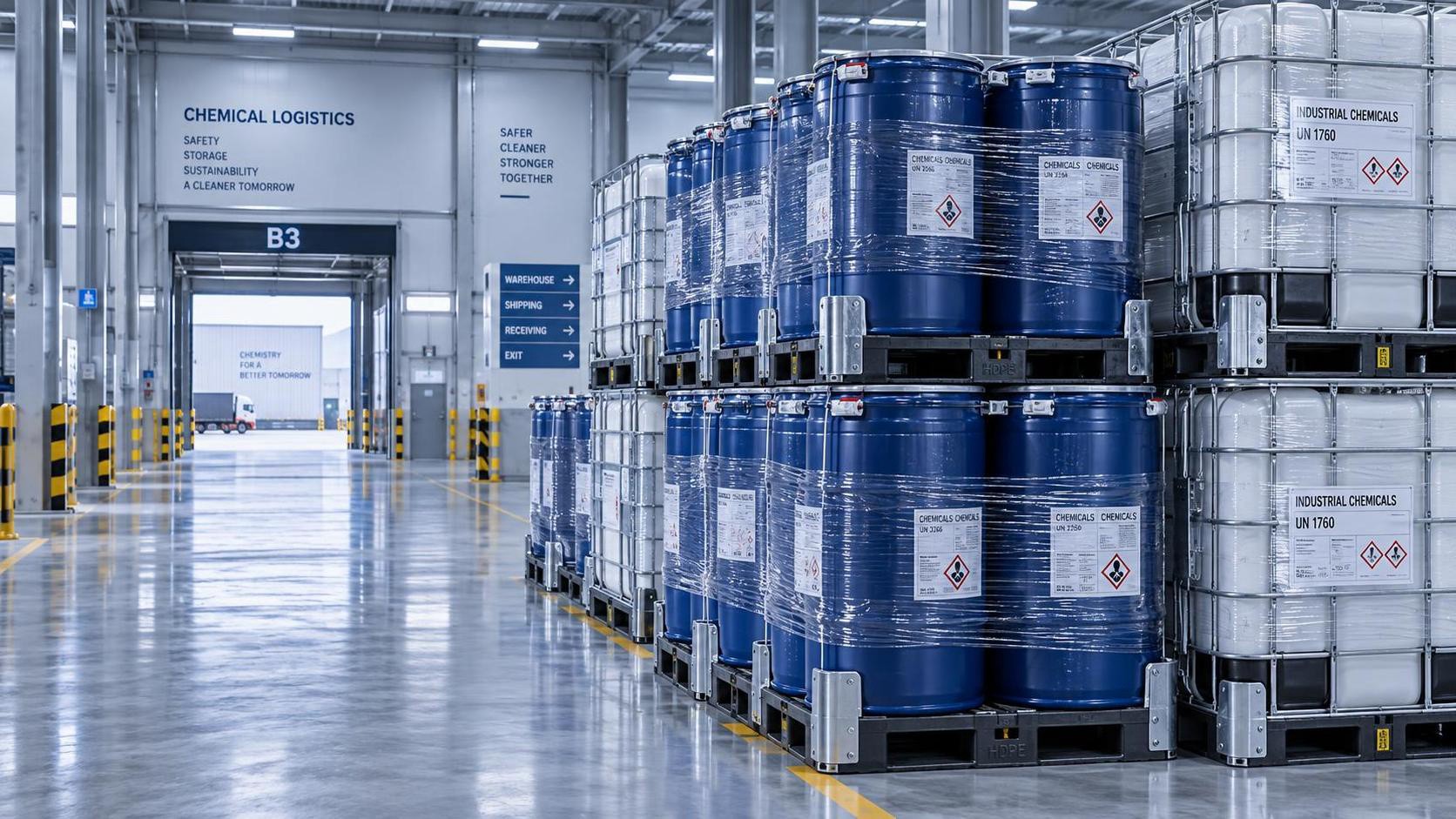
For export-oriented supply chains, packaging is more than a logistics detail. High-purity chemical raw materials need packaging that protects product integrity during storage and transit while fitting the customer’s handling equipment and applicable transport requirements. Drum, intermediate bulk container, or smaller-pack selection should consider consumption rate, dispensing method, warehouse space, exposure risk, and the ability to maintain batch traceability after receipt.
Evaluate the Supplier Beyond the Certificate of Analysis
For industrial buyers, consistency is often more valuable than an attractive initial price. A certificate of analysis is necessary, but it does not answer every operational question. Quality teams may need to review active content specifications, appearance, assay method, impurity controls where relevant, storage guidance, shelf-life information, and batch documentation. Formulators may also need information about the product’s solvent system, ionic character, compatibility boundaries, and recommended handling conditions.
A reliable manufacturing and export partner should be able to support this discussion without reducing it to a sales conversation. For global industrial operations, professional logistics handling and tailored packaging can be decisive when material must arrive in suitable condition across long transit routes or when a plant’s receiving process has strict limits. The best supplier relationship is one where technical documentation, packaging choices, and delivery planning are aligned before the material reaches the site.
Regulatory responsibility also needs clear boundaries. Requirements for disinfectant actives, biocidal products, labeling, and permitted efficacy claims can differ substantially by country or region. A raw-material supplier can provide relevant product documentation, but the legal status and claims of the finished disinfectant must be checked against the rules of the market where it will be sold or used.
A Practical Approval Route for Quality and Safety Teams
Before approving a quaternary ammonium-based solution, bring quality, EHS, operations, maintenance, and procurement into the same review. Quality may focus on microbial control, while maintenance sees the coating risk and operations sees the real contact-time problem. None of those perspectives is sufficient alone.
A useful approval route is to screen documentation first, then conduct a small, controlled site trial using representative surfaces, normal water, actual application tools, and typical staffing conditions. Observe more than microbiological outcomes where relevant: look for residue, odor, drying speed, user behavior, slip concerns, equipment response, and dilution errors. Revise the procedure before expanding use. If the procedure only works when a specialist supervises it, it is not yet a stable routine.
The right Quaternary Ammonium Compounds are the ones that fit a disciplined system: appropriate claims, validated concentration, adequate wet contact time, compatible surfaces, controlled dilution, and safe daily handling. Chemical selection sets the foundation, but the repeatability of the process is what ultimately determines whether surface disinfection remains dependable after the initial rollout.